Seizure of marital assets in criminal proceedings in Ukraine: Oleksandr Tananakin on the practice of the High Anti-Corruption Court of Ukraine and the challenges of protecting the rights of the non-suspect spouse
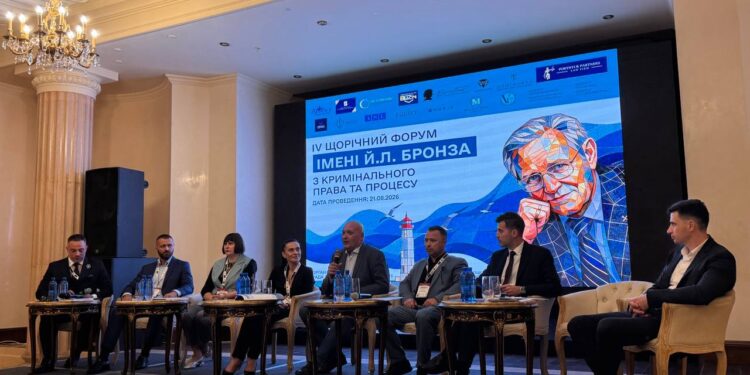
A forum on criminal law and procedure named after prominent Ukrainian lawyer Yosyp Bronz was held in Odesa, bringing together members of the legal profession, the judiciary and the broader legal community to discuss current issues facing criminal justice and legal practice in Ukraine.
One of the speakers was Oleksandr Tananakin, Managing Partner at Barristers and Deputy Chair of the Criminal Law and Procedure Committee of the Ukrainian National Bar Association.
Before addressing the main topic of his presentation, Tananakin raised two procedural issues arising in Ukrainian criminal procedure.
The first concerned situations in which the statutory period of pre-trial detention expires while an appellate court is considering the issue of territorial jurisdiction. According to the lawyer, there have been cases in Ukraine where appellate courts, while deciding whether a case should be transferred to another court, have simultaneously extended the defendant’s detention even though the extension of the preventive measure was not formally part of the matter under review.
This raises the question of whether an appellate court may extend a preventive measure while effectively ruling on an issue outside the scope of the proceedings, and how an individual’s right to appellate review of such a decision can be safeguarded.
Tananakin also highlighted a practical concern: where an appellate court both determines territorial jurisdiction and extends detention, the person concerned may effectively lose the opportunity to challenge the detention order before another judicial instance. Judges participating in the discussion acknowledged that there is currently no consistent approach to such cases in Ukraine and that an appropriate procedural mechanism remains to be developed.
The second issue raised by the Barristers representative concerned special court proceedings conducted in the absence of the accused and, in particular, the meaning of an accused person’s “appearance” before the court.
Tananakin noted that Ukrainian criminal procedure legislation does not clearly define this concept and questioned whether an accused or suspect’s participation in a court hearing by videoconference can be regarded as a voluntary appearance before the court. In his view, participation by video link should not automatically be treated as equivalent to the person’s physical appearance in court.
He stressed that this distinction may have significant procedural consequences. In particular, he cautioned defence lawyers against advising clients to participate remotely without first explaining the potential implications for subsequent appeals and for the right to a retrial after the person physically returns to Ukraine.
Participation by videoconference, he argued, does not automatically eliminate all statutory grounds for conducting special proceedings, particularly where the person remains outside Ukrainian jurisdiction.
Seizure of marital property in Ukrainian criminal proceedings
Turning to the main subject of his presentation, Oleksandr Tananakin focused on the seizure of jointly owned marital property in criminal proceedings falling within the jurisdiction of the High Anti-Corruption Court (HACC) of Ukraine.
According to Tananakin, over the past two to three years, judges of the HACC and its Appellate Chamber have increasingly ordered the seizure not merely of the suspect’s share of marital property, but of the entire pool of jointly owned marital assets. Such decisions have been justified on the grounds that the spouses’ respective shares have not been formally determined and that the seizure is necessary to secure potential confiscation.
In Mr. Tananakin’s view, this approach directly affects the rights of the other spouse, who is not a suspect in the criminal proceedings but may nevertheless be deprived for years of the ability to use or dispose of his or her share of the property.
The issue extends beyond real estate and vehicles to cash and bank funds, business income, salaries, securities and income derived from them.
The lawyer also highlighted inconsistencies in Ukrainian case law concerning the appropriate legal remedy available to the non-suspect spouse.
For some time, Ukrainian courts took the view that disputes over ownership shares in jointly owned marital property should be resolved through civil proceedings. The spouse would therefore have to bring a separate claim seeking division of the marital property or determination of his or her share, and only then seek the lifting of the seizure.
In practice, however, such claims have sometimes been dismissed, or relevant judgments have subsequently been overturned on the grounds that the property was already subject to a seizure order issued by the HACC.
This creates a legal Catch-22: the non-suspect spouse may effectively have no effective mechanism for obtaining the release of his or her share from the seizure.
At the same time, in 2024, the Appellate Chamber of the HACC issued decisions indicating that, where seizure is imposed to secure potential confiscation, it should extend only to the suspect’s share rather than to the entire pool of jointly owned marital property.
Mr. Tananakin supported this approach, emphasizing that the mere fact that an asset is jointly owned by spouses cannot, in itself, justify restricting the rights of the non-suspect spouse.
In his view, the purpose of the seizure should be the decisive consideration. Where an asset is seized to secure potential confiscation as a criminal penalty, there is no legal basis for extending the seizure to property that could not ultimately be confiscated.
He noted that, even if a conviction results, confiscation cannot automatically encompass all property jointly owned by the spouses. Accordingly, seizing the entire asset may go beyond the legitimate purpose for which the measure is imposed.
Mr. Tananakin also distinguished between the seizure of a share in jointly owned property to secure potential confiscation and the seizure of the entire asset where the purpose is to secure potential special confiscation.
He stressed that these are legally distinct situations.
In his view, the lack of a consistent judicial approach creates a risk that asset seizure could be used not only as a procedural safeguard but also as a means of exerting de facto pressure on a suspect and his or her family.
Who owns the property?
Another issue identified by Tananakin concerns cases where, in deciding whether to seize an asset in Ukrainian criminal proceedings, the court is effectively required to determine who owns the property — the suspect or the other spouse.
The lawyer questioned whether such property disputes should be determined by an investigating judge within criminal proceedings, given that the subject matter of seizure proceedings is governed by entirely different procedural considerations.
At the same time, he emphasized the presumption of equal ownership shares between spouses in jointly owned marital property, which, according to Tananakin, has also been recognized in the case law of the Criminal Cassation Court within the Supreme Court of Ukraine.
Nevertheless, the case law of the HACC and its Appellate Chamber remains inconsistent. Some decisions have limited the seizure to one-half of the property, while others have authorized the seizure of the entire jointly owned asset.
Mr. Tananakin therefore argued that this category of cases requires greater consistency in judicial practice and clearer legal standards capable of balancing two competing objectives: securing potential confiscation while avoiding unjustified restrictions on the property rights of individuals who are not parties to the criminal proceedings.